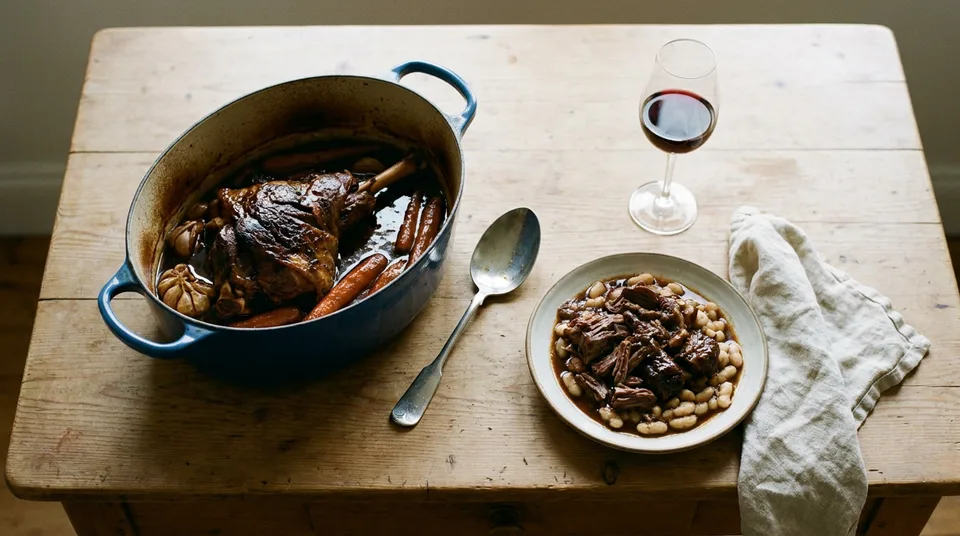
Ingredients
Lamb and braising ingredients
Method
- Ask the butcher to bone the leg, leaving the shank bone, and lard it with the pork fat. Heat the oven to 150°C / 302°F.
- Brown the lamb on all sides in a little of the oil in the casserole; remove it. Lightly colour the carrots, remove them, then line the casserole base with the pork rind.
- Return the lamb and carrots. Add bay, thyme, the halved garlic head, garlic cloves, Cognac, tomato paste and water with the stock powder dissolved in it. Season with salt and pepper. Close tightly. Put water in a recessed lid; if the lid is flat, put two glasses of water in a roasting tray in the oven.
- Bake for 7 hours, checking regularly that cooking juices remain. Add dry white wine during cooking if needed.
- Serve with white beans or oven-baked potatoes, as suggested by Larousse.
Equipment
Large ovenproof casserole with a tight-fitting lid; Oven; Roasting tray, if the casserole lid has no recess for water
Notes
- Butcher preparation: ask for the leg to be boned except for the shank bone, then larded with the pork fat. Arrange this before starting the recipe.
- Lid and water: close the casserole tightly. Fill a recessed lid with water, or put two glasses of water in a roasting tray in the oven when using a flat lid.
- During the braise: check regularly that juices remain. Dry white wine is the specified top-up liquid if needed.
- Plan and serve: allow the published hour of preparation and seven hours of oven cooking. White beans or oven-baked potatoes are Larousse’s suggested accompaniments.
Photos
1 photo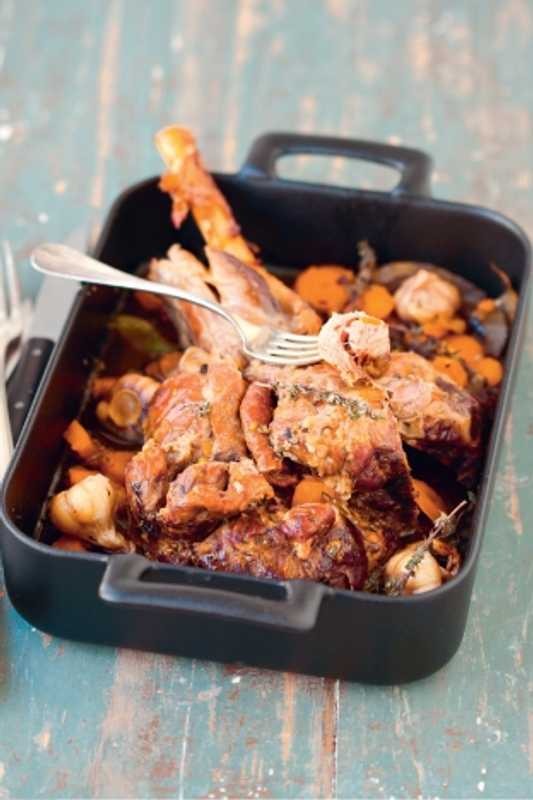
About this dish
Gigot de sept heures is a braised joint rather than a pink roast. Its other name, gigot à la cuillère, describes the tenderness that lets the meat be served with a spoon. A large piece cooks slowly with vegetables, herbs and liquid, bringing the meat and its juices to the table together.
The tradition reaches back at least to the early nineteenth century. Hervé This quotes André Viard’s 1806 Le Cuisinier impérial, in which partly boned mutton is larded and braised for seven hours with pork, vegetables and herbs. It is an early documented example, not an established account of the dish’s invention.
This formulation comes from Petit Larousse des saveurs des régions de France. Larding carries pork fat into the joint, and a layer of rind sits beneath it in the casserole. Browning gives the braise its first savoury notes before garlic, Cognac, thyme and tomato join the cooking juices.
Recipe and cooking notes adapted from Éditions Larousse.