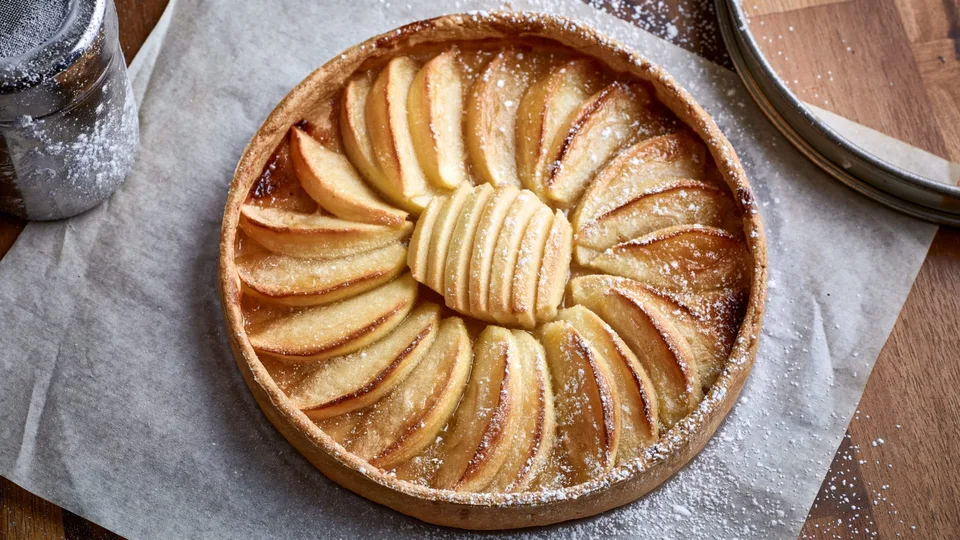
Ingredients
Shortcrust pastry
Apple filling
Custard and finish
Method
- Pulse the flour, butter and salt in a food processor until sandy. Add the pastry egg and cold water and pulse briefly to bring together. Avoid overmixing, which reduces flakiness.
- Turn onto a lightly floured worktop and knead with your palms for about 30 seconds, until smooth and combined.
- Flatten the dough to 1 cm thick, sandwich between two large sheets of cling film and chill for 30 minutes.
- Heat the oven to 220°C / 440°F / Gas 7, as printed by BBC, with a baking tray inside.
- Roll the chilled dough between the film to 2 mm thick. Set the 22 cm diameter, 2 cm deep tart ring on a greaseproof-lined wooden peel or baking tray. Remove the upper film, lift the pastry into the ring with the remaining film facing up, then lift and tuck it into the base and sides. Remove the film and trim excess pastry with the rolling pin.
- Pinch and press the pastry to stand 2 mm above the rim. Prick the base with a fork and chill for 20 minutes.
- Meanwhile, melt the filling butter with the lemon juice and 15 g of the caster sugar in a small pan, stirring until the sugar dissolves. Remove from the heat, stir in the Calvados and set aside.
- Arrange the apple segments in overlapping concentric circles in the chilled case. Brush with the Calvados mixture. Slide the tart ring onto the hot tray and bake for 10 minutes.
- Lower the oven to 200°C / 400°F / Gas 6 and bake for another 20 minutes, until the pastry is pale golden and the apples caramelised.
- Whisk the double cream, custard egg and remaining 50 g caster sugar together. Sprinkle the tart with the additional tablespoon of sugar specified in the method, pour in the custard and bake for another 10 minutes, until just set.
- Cool for 1 hour before carefully removing the ring. Dust with icing sugar and serve immediately.
Equipment
Food processor; 22 cm diameter, 2 cm deep tart ring; Baking tray; Wooden peel or second baking tray; Greaseproof paper; Cling film; Rolling pin; Fork; Small saucepan; Pastry brush; Whisk
Notes
- Apples: use the BBC recipe's Cox's Orange Pippin, Worcester, Russet or Braeburn. Peel, core and cut each into ten segments.
- Pastry: pulse briefly and stop once combined, since overmixing reduces flakiness. The pastry uses one whole egg and one teaspoon of cold water, added together; the custard has its own separate egg.
- Rolling and lining: keep the dough between sheets of cling film while rolling. Lift and tuck it into the 22 cm ring rather than stretching it. Chill the dough for thirty minutes and the lined case for twenty minutes.
- Sugar: divide the listed 65 g caster sugar into 15 g for the apple glaze and 50 g for the custard. The Method then calls for another tablespoon over the apples before the custard goes in; keep that additional spoonful separate from both measured portions.
- Baking and cooling: the BBC headline says 10–30 minutes cooking, while its written stages total forty minutes. Follow the 10-, 20- and 10-minute stages, then cool for one hour before removing the ring.
- Demonstration: open the BBC Food recipe link above to watch the five-minute demonstration. Its player is not embedded here; the separate pastry how-to links are general technique guides.
Photos
1 photo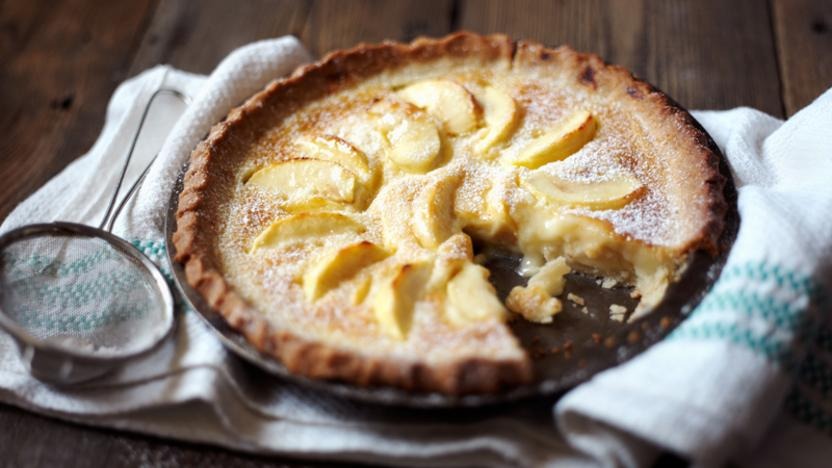
About this dish
For Raymond Blanc, his mother's apple tart was the best in the world. Its success, he explains, rests on simplicity and apples with the right balance of sweetness, acidity and fragrance. That family affection gives Maman Blanc's tart its character: familiar fruit and pastry treated with care, with a little custard to bring them together.
Apple tarts filled with egg-and-cream custard also belong to the regional repertoire of Alsace, where the flan is a defining feature. Blanc's tart has its own Calvados-and-lemon accent. This selected version comes from BBC Food and Raymond Blanc's Kitchen Secrets, in the Apples episode.
The apples bake first, brushed with butter, lemon, sugar and Calvados, so their edges caramelise before the custard goes in. A final short bake leaves the filling just set. Careful pastry handling matters too: a thin shell supports the fruit without becoming the main event.
Recipe and cooking notes adapted from BBC Food.